Back in June 2024 I wrote about Oklahoma Teacher Retirement. Now, in early 2026, my preparations have begun for my mid-year retirement, which will occur about a month before I reach 60 years of age. I have filed my application with the teacher retirement system, agreed to new segmented accounts for the monies I’ve accumulated in various retirement funds, and arranged my post-retirement/pre-Medicare health insurance.
Retirement Funding
I selected the pension option where if I die before her, my wife will receive my monthly pension for the remainder of her life. I also opted for a Partial Lump Sum distribution which will be combined with the traditional IRA I contributed to from 1989 to 2014, the Roth IRA I have contributed to since 2015, and the 403(b) plan I have contributed to since 1992. All of those funds will flow into various accounts per an Advanced Time Segmentation plan.
Advanced Time Segmentation
I opted for a Partial Lump Sum, which reduced my pension by 17%, in order to boost my total investments pool as a hedge against inflation. That is important to me since the Oklahoma Teacher Retirement System (OTRS) stopped providing annual cost-of-living adjustments (COLAs) long ago. The legislature only rarely provides tiny adjustments, the last being a 2-4% increase in 2020 after a dozen years without one, while the Consumer Price Index increased by almost 50% between 2008 and 2025.
I plan to start drawing my Social Security retirement benefit in a couple of years when I turn 62. Three factors motivated my decision to take it as soon as possible:
Social Security benefits, unlike OTRS, do have annual COLAs, based on the percentage increase in the Consumer Price Index for Urban Wage Earners and Clerical Workers. That will help offset health insurance/Medicare cost increases.
The dysfunctional federal government has done nothing to stave off the exhaustion of the Retirement & Survivors Fund in 2033, meaning there could be benefit cuts of up to 23% in the coming years. Best to get whatever I can, as soon as possible, since Congress and the President might eventually allow benefits to drop significantly, decrease or suspend the annual COLAs, etc.
Even if Congress somehow protects my Social Security benefit, waiting to collect it until age 67 would not increase my lifetime payout until I am over 75 years old, if I even survive to that age. I’d rather enjoy those benefits for over a dozen years when I’m younger and healthier.
An example of breakeven ages if I delayed taking Social Security, based on my latest Social Security statement and this calculator
Bear in mind that calculation does not factor in COLAs or the unknown changes in Social Security that must occur within the next seven years. My stance on Social Security might be different if I lacked my teacher pension and had not spent decades building up my retirement savings.
Health Insurance
My health insurance has evolved over time. When I began teaching in Bartlesville in 1989, the district had a self-funded plan. As of 1991, the monthly premium was $118, or $277.29 in 2025 dollars adjusted for inflation according to the Consumer Price Index. Now the monthly premium is $707.00, with the inflation rate for health insurance premiums being much higher than for the overall economy.
Oklahoma teachers’ premiums for HealthChoice High insurance have been fully paid by the state since 2004. At the time, the monthly premium was $292.54 or $498.15 in 2025 dollars. The chart below tracks my monthly health insurance premiums, in inflation-adjusted 2025 dollars, and compares that to the average among firms in the South employing 200-1000 workers.
It is no surprise that the health insurance costs have increased far above the overall rate of inflation. Over the course of my career, the real cost of health insurance increased by a factor of 2.5, although it has stabilized over the past decade. However, I have been insulated from those increases for over 20 years because Oklahoma began paying for public school educators’ single health insurance premiums in 2004.
For the five years until I qualify for Medicare, I’ve opted to stay with the state’s HealthChoice High insurance plan. The retirement system will pay $102/month towards my premium, which will start out at $707/month plus $48.58/month for HealthChoice Dental insurance. I’m also keeping an American Fidelity cancer and intensive care unit insurance policy I obtained in 2009 which costs me $32.45/month.
So for five years I’ll be paying out-of-pocket at least $686 per month or $8,232.36 per year for health, dental, and cancer insurance until I qualify for Medicare. Given the structural defects in our health care system, I won’t be surprised if the cost of my health insurance rises above the overall rate of inflation.
Oklahoma ranked 49th in health care among the states and the District of Columbia, with only Texas and Mississippi below us. Our state is 48th in health care access and affordability and is among the bottom-five in a slew of categories: uninsured adults, Medicare spending, adult cancer screenings, dental visits, COVID-19 vaccinations, children without mental health care, avoidable emergency department visits for the elderly, premature deaths from treatable and preventable causes, suicide rate, colorectal cancer deaths, smoking, adults lacking care due to cost, children’s medical and dental visits, and hospital admissions. None of that helps my insurance costs.
Transitional Period
A decade ago, when I agreed to occupy a new district administrative position over technology and communications, the school board president of the time, the superintendent, and I acknowledged that the position was an unusual one unlikely to survive my tenure. I had a specific role to play in modernizing those aspects of the district, and now that mission has concluded. In the summer of 2026, the district will have a new superintendent, and she has begun the process of establishing a new administrative structure.
My roles will be spread among multiple administrative positions, and I have crafted a multi-year roadmap and instructions that could be used to sustain the district’s technology and communications programs while they evolve into new forms. New central office administrative positions have been posted and should be filled in a few weeks.
My office from 2017 to 2026
I’ll then begin a transition process with the new administrative designees, and at some point I will vacate my office at the Education Service Center. My retirement reception is set for May 19, 2026 and I’ll officially retire on June 30, a day before Wendy and I celebrate our tenth wedding anniversary.
Wendy is nine years younger, so after I retire she will continue to lead the Student Technology Support Team at Bartlesville High School, working with students to maintain the thousands of Chromebooks used across the school district.
The time of transition has arrived. As Fred Rogers wrote, “Transitions are almost always signs of growth, but they can bring feelings of loss. To get somewhere new, we may have to leave somewhere else behind.”
Light reading is important to me, with trusted authors and series offering safe harbors when I’ve had enough of the sometimes stormy sail of reading literature, once I’m tired of nonfiction, or whenever I’m stressed.
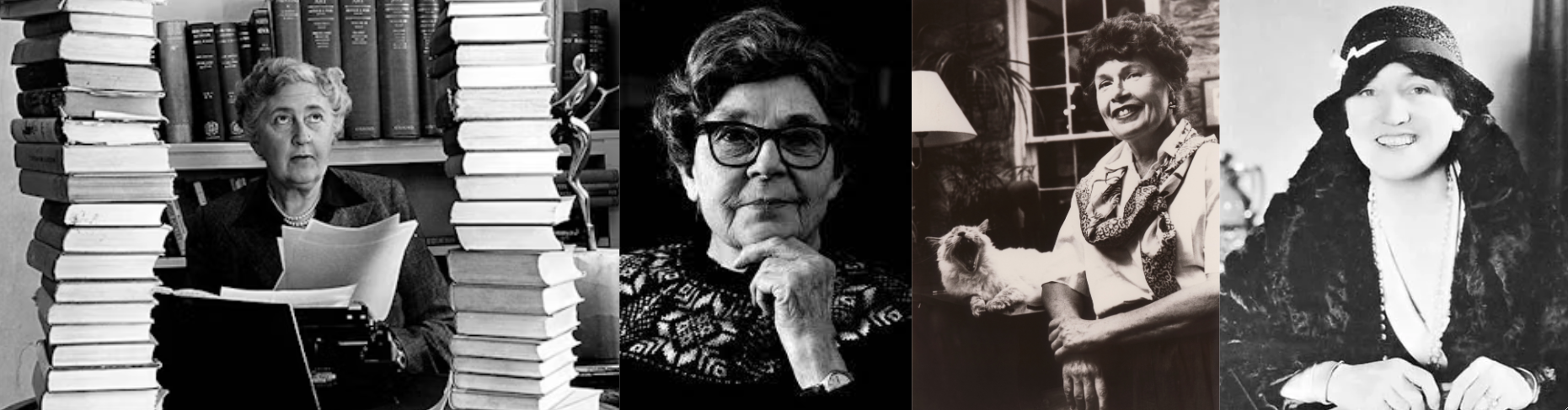
In the early 2010s, I was driving out to day hike on most weekends, and I listened to every Agatha Christie audiobook there was, at first on cassette tapes checked out from the Tulsa libraries and later via purchases on Audible. She remains my favorite for audiobooks, but I exhausted her numerous mysteries long ago.
It was many moons ago that Carrie, my friend who is a librarian, put me onto Ellis Peters’ Brother Cadfael Chronicles, which were actually authored by Edith Pargeter. I read or listened to all of those, then all of her Inspector Felse mysteries, and having exhausted the supply of audiobooks, now I’m working my way through her standalones on my Kindles. She is not as cunning a plotter as Christie, nor as skilled with dialogue, but Pargeter brings a wonderful sense of realistic morals, atmosphere, and empathy to her stories that made her my favorite after Christie.
My favorite mystery series authors of the past include Christie, Pargeter, Mertz, and Rinehart
Whilst seeking more Ellis Peters audiobooks, I stumbled into Elizabeth Peters stories, actually authored by Barbara Mertz. While I loved her Vicky Bliss and Jacqueline Kirby series, especially when Grace Conlin voices Herr Professor Anton Z. Schmidt in the audiobooks, I don’t care for the characters of her Amelia Peabody novels and found the books Mertz penned as Barbara Michaels too predictable and angry. So I’m done with her works.
Anxious to find more offerings, I tried Mary Roberts Rinehart, who was called the Agatha Christie of America, although her work is often far more dated. Audible is also my preferred format for Rinehart stories, and I am happy to find that Audible has been adding more titles. For awhile, several of her audiobooks had a terrible unprofessional narrator, but that appears to have been rectified. The age and variability of her novels leads me to place more trust and confidence in what remains of Pargeter and now Mary Stewart.
Mary Stewart
I’d read the first of Mary Stewart’s five Arthurian novels, but I didn’t continue with them, as that genre just isn’t for me. Happily I recently discovered her romance suspense novels, enjoying one from 1962 before zipping back to her first from 1955. As Elsie of the Tea and Ink Society has documented, Stewart authored 15 non-Arthurian romance suspense novels, so I am lucky to still have a baker’s dozen to savor.
I plan to parcel those out over time, as I do with Edith Pargeter’s works. I usually avoid binging on videos or books available in series, finding that can decrease my appreciation and enjoyment. That’s why I wait months before listening to another of Richard Osman’s audiobooks. I’m so invested in his Thursday Murder Club characters, and his works include such pathos, that they are special treats for me rather than light reading.
I haven’t always succeeded in my attempts to find new series. I read the first Flavia de Luce mystery by Alan Bradley, a series that my late acquaintance George Parks enjoyed, but it wasn’t my thing. I also read the first of Dorothy Sayers’ Lord Peter Wimsey series, but I found that character insufferable.
I asked Google’s AI for authors similar to Mary Stewart, and for classic authors it offered up Daphne du Maurier, Phyllis A. Whitney, M.M. Kaye, and Rinehart. I read du Maurier’s short story “The Birds”, which Hitchcock adapted into his famous film, years ago. While I liked it, I couldn’t get into Rebecca, her most famous novel and Hitchcock’s first American film. I have a feeling her blend of atmosphere and action is weighted too much toward the former for my taste. However, I did enjoy the Mexican Gothic novel The Hacienda by Isabel Cañas, which was clearly influenced by du Maurier. The “modern” mystery authors that Google suggested were Ruth Ware, Susanna Kearsley, and Michaels.
Louise Penny
Over the years, I’d seen mentions of Louise Penny’s Three Pines mysteries featuring Chief Inspector Gamache. I’m no Francophile, so the setting of rural Quebec, where French is the sole official language, was more repulsive than attractive from a distance. However, when I saw her work again recommended by friends on Facebook, I finally sampled the first novel, Still Life. It was published back in 2006, and the series is clearly successful since it had grown to 19 books by 2024.
The Three Pines mysteries are my new series
I was immediately drawn to Penny’s emphasis on characterization and the sharper edges of modernism amidst her cozy tale. I enjoyed her emphasis on community and belonging and appreciated that she never let the French become intrusive. I was also impressed by the resources on her website. Reportedly four out of every five people hear an “inner voice” when reading silently, and they should appreciate the pronunciation guide she provides, although I lack any sort of interior monologue, so that is less important for me.
P.G. Wodehouse
Besides most mysteries, humor is another genre that I consider light reading. However, I’m quite selective. Back in 2021-2022, I listened to a dozen P.G. Wodehouse novels, mostly in the Blandings Castle series. I was binging on them as an escape from the stresses of the Covid-19 pandemic, but they became formulaic. So I took a nine-month break before listening to another, and it has now been 19 months since I listened to one.
I will continue to avoid the three remaining Blandings Castle books for some time, as I’m quite tired of pigs. I instead plan to eventually listen to Sam the Sudden, the last novel that includes Lord Tilbury, who has been my favorite Wodehouse character. I don’t think Jeeves & Wooster would be to my taste, so after that it might be standalones as far as Wodehouse.
I liked Douglas Adams‘ Hitchhiker’s Guide series, in any media format, although its frenetic pace meant that reading them in succession gave me a headache. I’ve had an audiobook of Dirk Gently’s Holistic Detective Agency downloaded into iTunes for well over a decade, but I have yet to engage with it.
I am delighted to have novels by Penny, Stewart, and Pargeter in hand, and audiobooks by Osman and others in ear, to ease my transition in mid-2026 from 40 years of employment into an unknowable number of years of retirement.
Who will it be? So asked Luis Demetrio in 1953 in his lyrics for the song he wrote for singer Pedro Infante, with the first few chords provided by bandleader Pablo Beltrán Ruiz.
Who will be the one who loves me? Who will it be? Who will be the one who gives me her love? I don’t know if I’ll be able to find her I don’t know if I’ll love again I’ve wanted to relive The passion and warmth of another love Another love that would make me feel That would make me happy, like I was yesterday
That tune might well be familiar to you, but with the title of Sway and different English lyrics that American songwriter and lyricist Norman Gimbel applied to it. There are many covers of it, including:
Who will it be, indeed! There was even a version by the actor Brent Spiner, who played Data in Star Trek: The Next Generation…but I’ll leave finding that as a mercifully optional exercise for the reader.
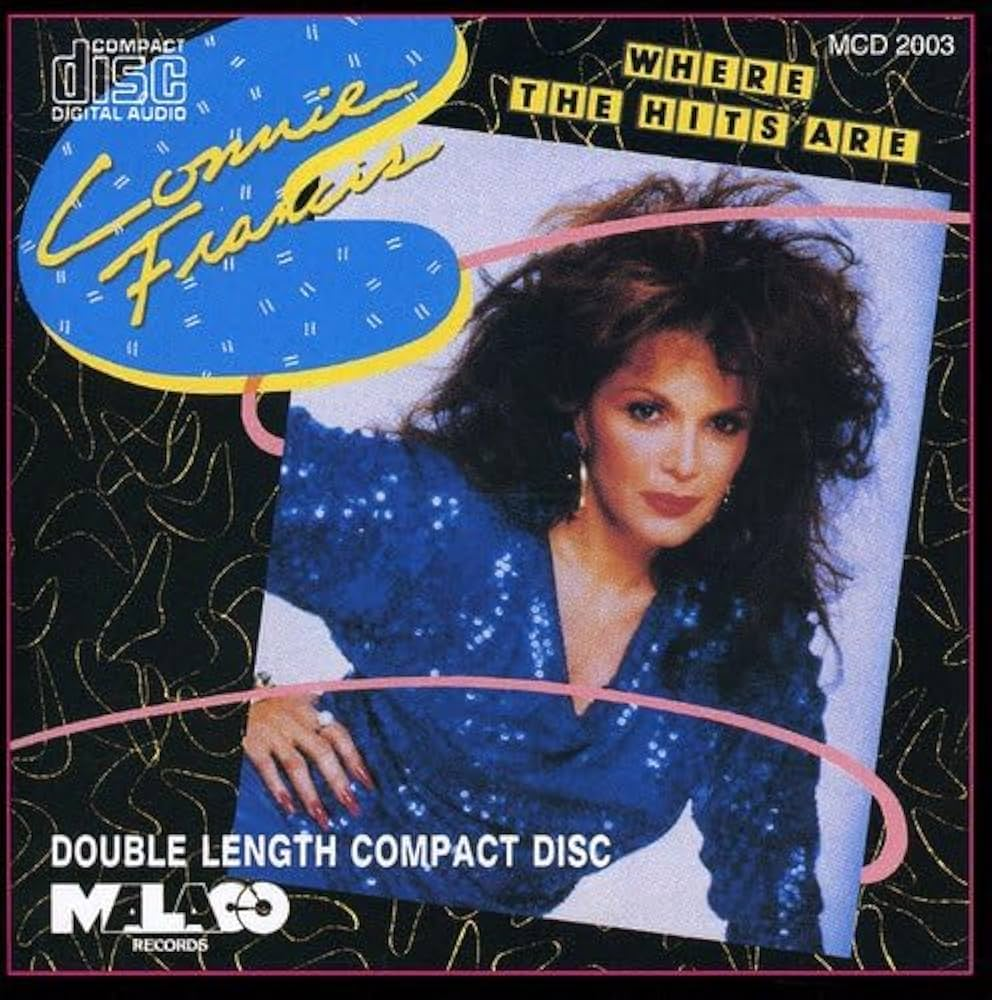
I first encountered the song in Dark City, but I want to highlight the 1960 version by Connie Francis because she sang the original Spanish lyrics with just a line from Norman Gimbel’s version at the end.
I wasn’t at all familiar with Francis, even though she was the most popular female singer in the USA between 1958 and 1964. Her final top-ten hit was in 1962, and her last top-forty entry in 1964, two years before my birth. A 2022 survey showed that she had more of her songs dropped from radio airplay than anyone other than the Osmond family. A brief odd resurgence came in May 2025 when her 1962 song Pretty Little Baby went viral on TikTok, but she died in July.
I decided to learn more about Concetta Rosa Maria Franconero, who was convinced at age 13, by television host Arthur Godfrey, to change her name. In 1957, she had a breakthrough covering the 1923 tune Who’s Sorry Now?
From 1955 to 1957, Francis had recorded 20 sides for MGM Records, with only one duet even making the charts. MGM gave her one last shot at a record before dropping her, and at the recording session in 1957, her father insisted on her covering Who’s Sorry Now?, convinced it stood a chance of becoming a hit because it was a song adults already knew and that teenagers would dance to if it had a contemporary arrangement.
Connie did not like the song and argued about it with her father heatedly, delaying the recording of the other two songs during the session so much that she thought no time was left on the continuously running recording tape. Her father insisted, however, and when the recording of Who’s Sorry Now? was finished, only a few seconds remained on the tape.
Months later, thanks to Dick Clark featuring her song on American Bandstand, over a million copies had been sold and Francis was suddenly launched into worldwide stardom. In April 1958, Who’s Sorry Now? reached number 1 in the UK and number 4 in the United States.
Connie’s strong and penetrating vocals remind me of the power of the other popular female singer during her hit-making era, Brenda Lee, or Little Miss Dynamite.
Francis recorded music in English, Italian, French, German, Greek, Swedish, Yiddish, Japanese, and Spanish. Curious about her songs in Spanish, I loaded her 1960 album Connie Francis Sings Spanish and Latin American Favorites on my iPhone and listened to it in the car while driving to a restaurant. I was startled when Vaya con Dios played. I’ve long been used to American mispronunciations of the song, such as you’ll hear in this version with guitarist and multi-tracking pioneer Les Paul and his wife Mary Ford:
Contrast that to the soft, slow, and far more accurate take on it by Connie Francis, who had studied Spanish in school:
I learned schoolboy Latin, not Spanish, but that sounds exquisite to my uninformed ear. Francis was not always so fluent in the other languages, and I laughed at her story of how her German version of Ev’rybody’s Somebody’s Fool, retitled Die Liebe Ist ein Seltsames Spiel, was considered unintelligible by Deutsche Gramophon. She badgered them to release it anyway, and they finally conceded after lopping off the first verse, and she crowed how it became “the best-selling non-local record ever in Germany”.
Why had I not heard more of Connie Francis in my youth? Well, in 1967, cosmetic nasal surgery made singing more difficult for her, with her having to avoid air-conditioned venues. Then, in 1974, she was brutally attacked.
That November, several months after a miscarriage, she was booked for eight performances at the Westbury Music Fair on Long Island, staying at a Howard Johnson’s Motor Lodge in Jericho, New York. While she was asleep on the morning after her second show, an unknown man entered her motel room through a sliding glass door that appeared locked but was easily unsecured from the outside. He brutally raped and beat her at knifepoint, bound her to a chair and tipped it over, and piled heavy mattresses on her. She managed to slowly crawl to dial the telephone for help.
The rapist was never captured, and the attack had varied consequences: Norwegian inventor Tor Sørnes was inspired to invent the keycard lock, while Francis successfully sued the hotel chain for poor security and that led to improvements at many lodges. However, the incident left Francis with post-traumatic stress disorder. She battled agoraphobia, depression, and developed an opioid medication addiction. A follow-up surgery to address her vocal problems only made things much worse, with even more surgeries before she could sing again. In 1981, her brother, an attorney who testified against mob activity, was shot to death by a paid of gunmen in his driveway.
Back when I was teaching physics, I would often play one of Connie’s songs for my students when we learned about nuclear energy. I showed them parts of the filmTrinity and Beyond, and her Where the Boys Aregraced a sequence about the last above-ground nuclear tests the USA conducted before the limited test-ban treaty took effect.
I’ll close by noting that the lyricist Gimbel also co-wrote Killing Me Softly With His Song and the English-language lyrics for The Girl from Ipanema, How Insensitive, and I Will Wait for You. There are many covers of that final song. The original version, Je ne pourrai jamais vivre sans toi, translates to “I could never live without you” and originated in the French musical drama Les Parapluies de Cherbourg (The Umbrellas of Cherbourg) with the original French lyrics by film director Jacques Demy, with Danielle Licari dubbing for Catherine Deneuve in the film. I have an optical disc of that awaiting my attention…when I’m ready to have my heart broken.
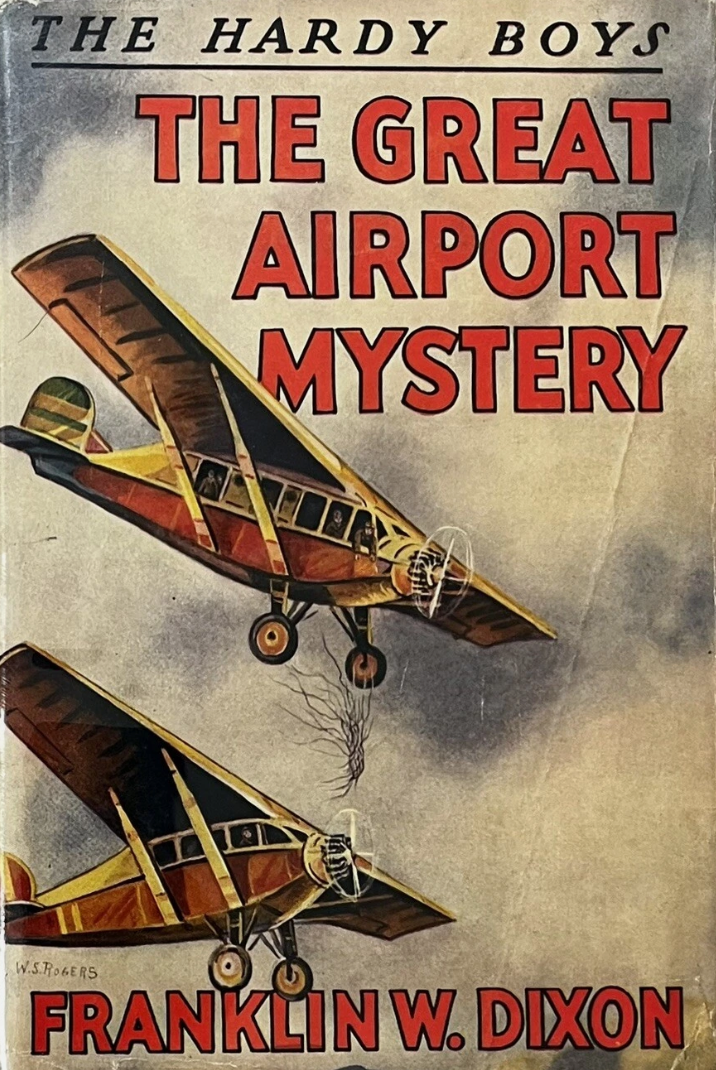
In recent years, the original editions of The Hardy Boys children’s books began their long slow march into the public domain. The first three were set free in 2023, three more in 2024, two in 2025, and The Great Airport Mystery is now fair game in 2026.
Mind you, only the older version written by Leslie McFarlane, involving pilot Giles Ducroy and an air mail robbery, has been freed. As I child in the 1970s, I read the more commonly available 1965 rewrite by Tom Mulvey, which is about pilot Clint Hill and stolen equipment. That revision will remain under copyright for 35 more years. Frankly, doublepun intended, I always liked The Three Investigators better than the Hardy Boys, but those better-written children’s mysteries won’t start entering the public domain until 2060, and they too underwent revisions with a contemporary reboot that began this year.
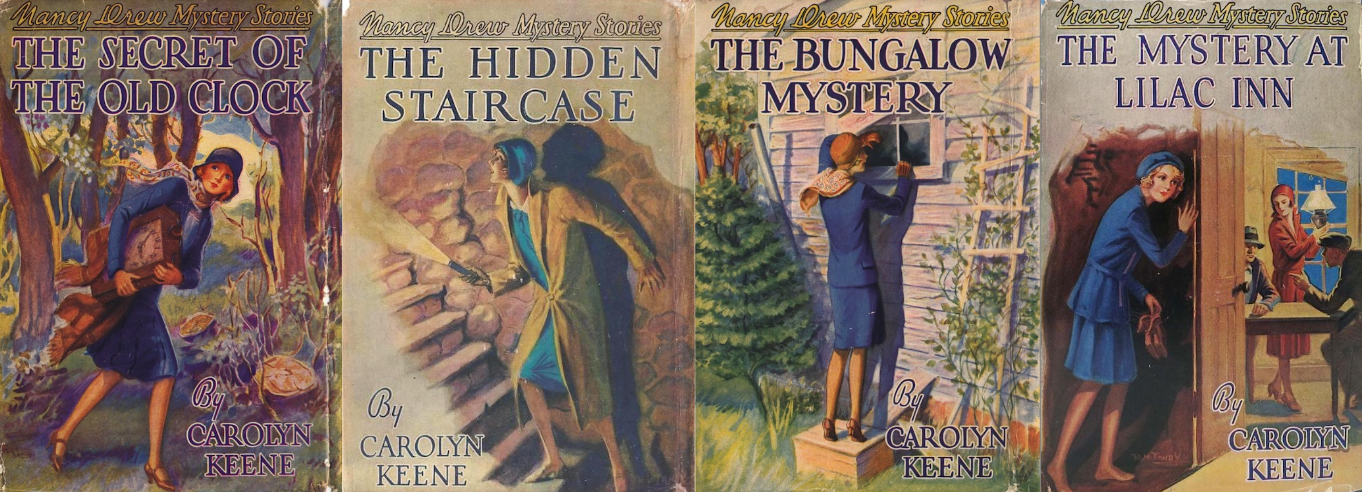
The Nancy Drew series began in 1930, so its first four entries have also now entered the public domain. The same caveat applies, with only the original versions ghostwritten by Mildred Wirt Benson losing their copyrights, with revised versions from 1959-1961 still being protected.
The original versions of the first four Nancy Drew books will be entering the public domain in 2026
Breaking the legal bonds holding The Hardy Boys and Nancy Drew captive is not much to crow about, so here are more significant 1930 books:
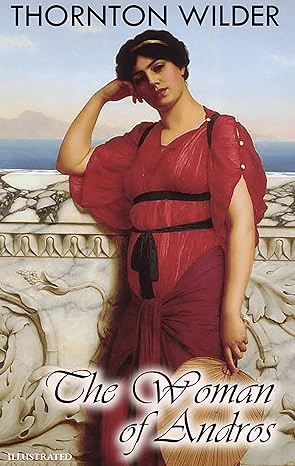
The Woman of Andros by Thornton Wilder
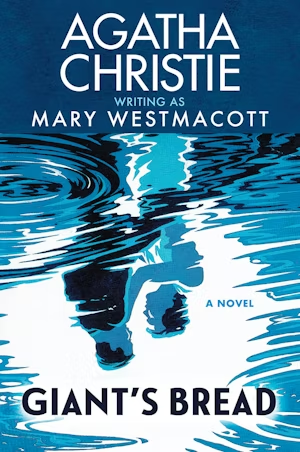
Agatha Christie’s The Murder at the Vicarage, The Mysterious Mr. Quin, and Giant’s Bread
The Maltese Falcon by Dashiell Hammett…the novel, not the 1941 Bogart film
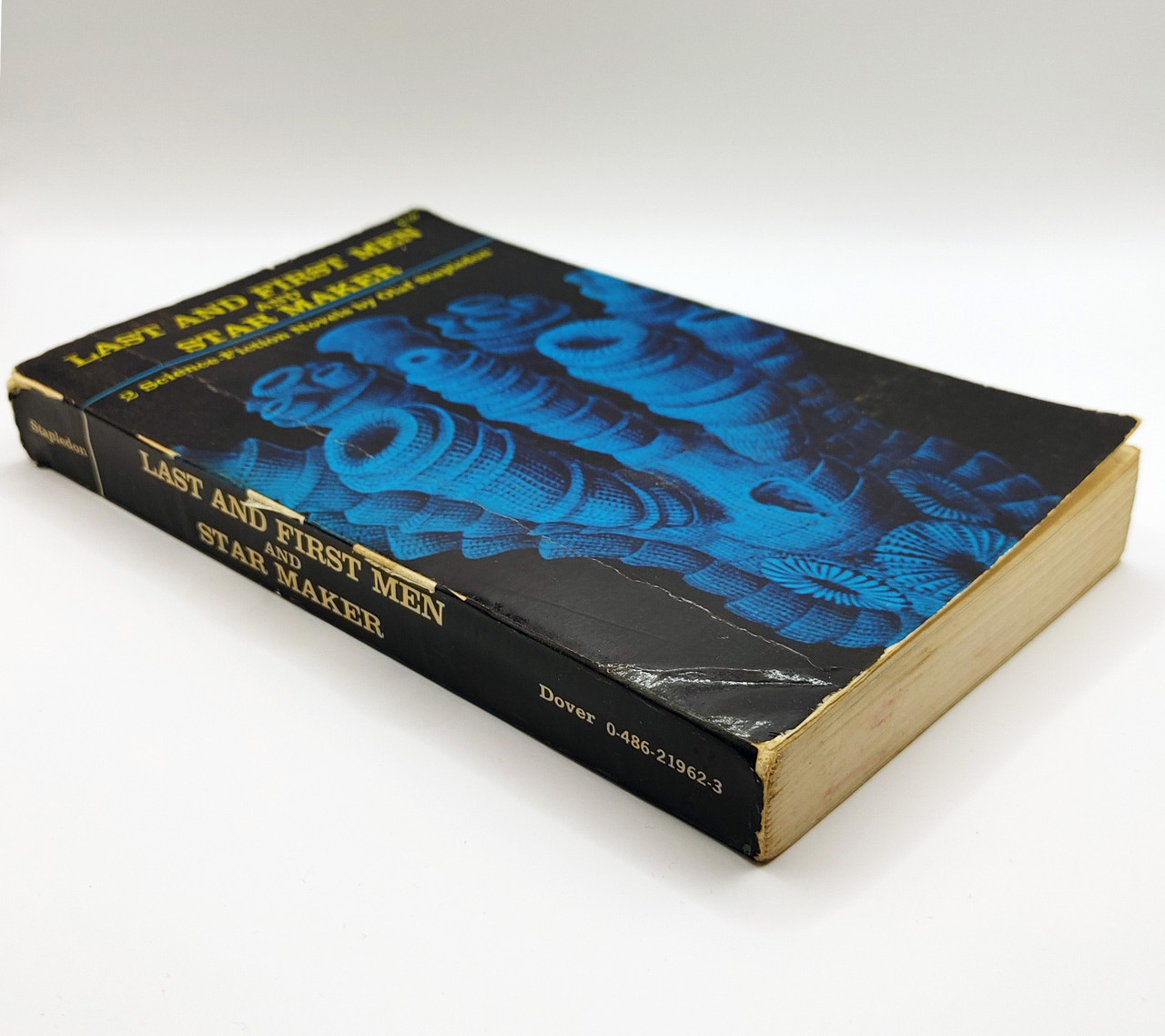
Last and First Men by science fiction author Olaf Stapledon
As I Lay Dying by William Faulkner
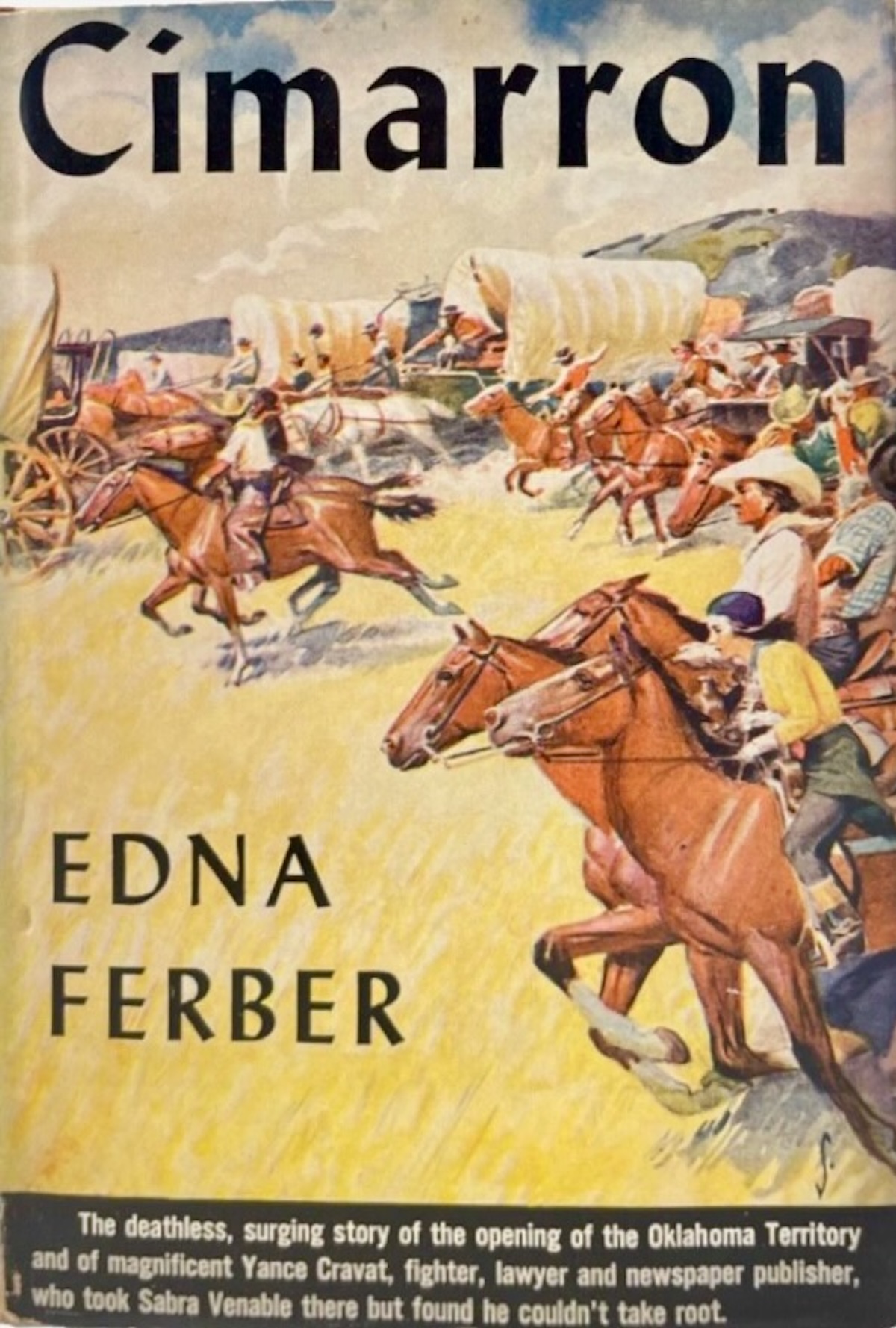
Cimarron by Edna Ferber
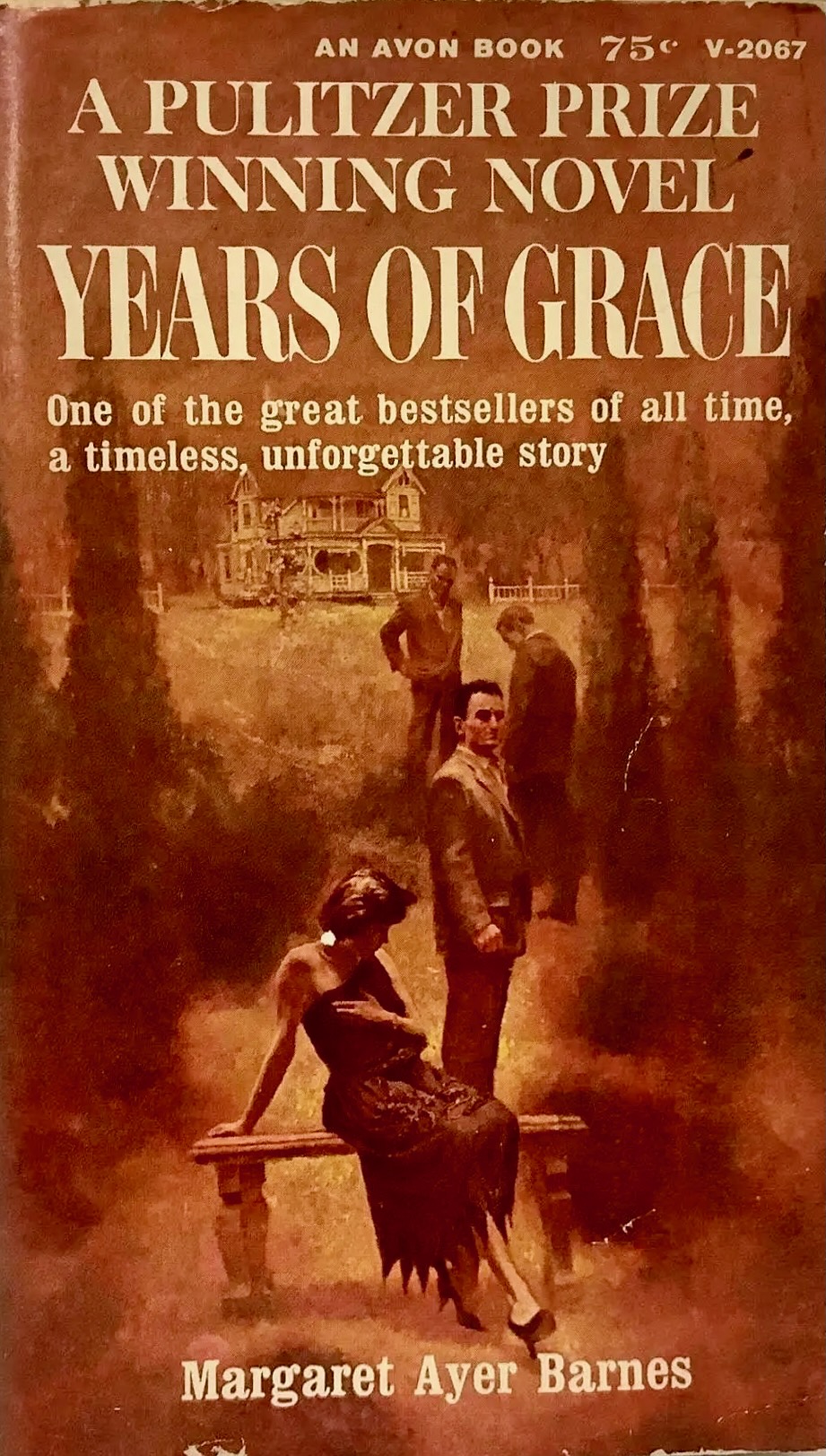
Years of Grace by Margaret Ayer Barnes
The Woman of Andros by Thornton Wilder
This one has a simply magnificent opening:
The earth sighed as it turned in its course; the shadow of night crept gradually along the Mediterranean, and Asia was left in darkness. The great cliff that was one day to be called Gibraltar held for a long time a gleam of red and orange, while across from it the mountains of Atlas showed deep blue pockets in their shining sides. The caves that surround the Neapolitan gulf fell into a profounder shade, each giving forth the darkness its chiming or its booming sound. Triumph had passed from Greece and wisdom from Egypt, but with the coming on of night they seemed to regain their lost honors, and the land that was soon to be called Holy prepared in the dark its wonderful burden. The sea was large enough to hold a varied weather: a storm played about Sicily and its smoking mountains, but at the mouth of the Nile the water lay like a wet pavement. A fair tripping breeze ruffled the Aegean and all the islands of Greece felt a new freshness at the close of day.
I would enjoy comparing Wilder’s take on ancient Greece to the works of Mary Renault that I read forty years ago for an undergraduate honors seminar.
Agatha Christie…and Mary Westmacott
Years ago, I consumed all of Agatha Christie’s mysteries. The Murder at the Vicarage is the first of her Miss Marple series, while The Mysterious Mr. Quin is a collection of short stories featuring the mysterious and somewhat supernatural Harley Quin and his companion, Mr. Satterthwaite.
I have not read the non-mystery books that Christie published under pen names, including Giant’s Bread, the first of six she published as Mary Westmacott. It is about a young composer who reinvents his identity after being declared dead in World War I, and one reviewer recommended it, although she thought the ending rather farcical.
The Maltese Falcon Escapes the Copyright Cage
One version of this prop sold for a cool $4 million in 2013
Dashiell Hammett was a former Pinkerton operative who wrote most of his hard-boiled detective fiction while living in San Francisco in the 1920s. The Maltese Falcon was his third novel and is considered his best work. His fifth and final novel, The Thin Man, was published in 1934, so it won’t be long until all of his work is freely available.
In text form, that is. You are more likely to be familiar with Bogey in a film version of The Maltese Falcon or possibly the six The Thin Man films with William Powell and Myrna Loy. The falcon’s film form won’t be freed until 2037.
Odd bits of trivia attach to the falcon props from the movie. One was given by studio chief Jack Warner to actor William Conrad…yes, the same actor who portrayed the overweight detectives in the Cannon and Jake and the Fat Man television series, who narrated Rocky and Bullwinkle and The Fugitive, and who portrayed Marshall Matt Dillon on the radio version of Gunsmoke. His prop was auctioned in 1994 for almost $400,000.
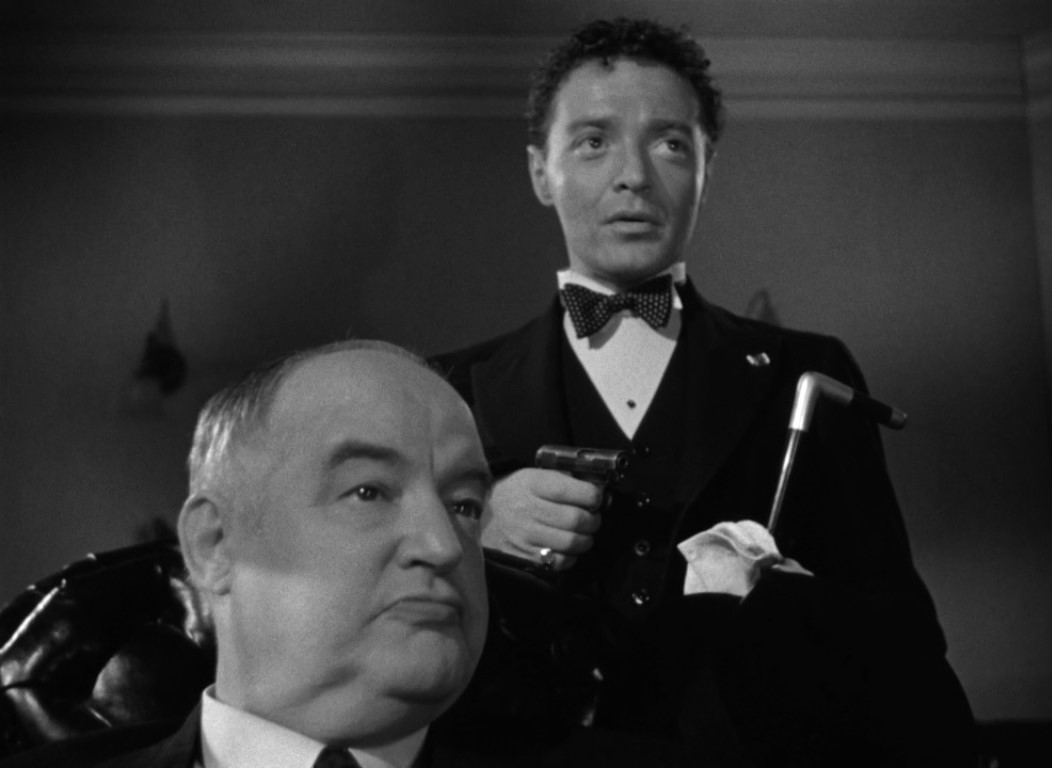
Sydney Greenstreet & Peter Lorre in the famous film noir
Not bad, but in the film, Sydney Greenstreet’s villain offered detective Sam Spade $50,000 for the statuette, which would be over a million 2025 dollars. Funly enough, a 45-pound metal version of the film prop was sold in 2013 for over $4 million.
The film was okay for me, with Sydney Greenstreet a standout, but I have no interest in reading the Hammett novel.
Olaf Stapledon’s Two Billion Years of Boredom
Not recommended
Stapledon’s Last and First Men: A Story of the Near and Far Future is a vast science fiction work reportedly summarizing two billion years of future development. I long had a 1968 paperback reprint of that 1930 work and his 1937 novel, Star Maker, but in my sampling of the former, I found it similar to J.R.R. Tolkien’s The Lord of the Ringsappendices or The Silmarillion: quite soporific. I am in no manner tempted to read a summation of two billion years of fake history.
In 2017, Icelandic composer Jóhann Jóhannsson’s only film premiered, and it was based on the book. It isn’t encouraging to note that Jóhannsson died a year later from a deadly combination of flu medication and cocaine. His sparse film version only runs 70 minutes, which is about fifteen trillion times shorter than the span of time in the book…but I’m skeptical that the abridgment is worth your time.
However, decades ago I did enjoy Charles Sheffield’s 1997 science fiction novel Tomorrow and Tomorrow: A Love Story to the Edge of Time, which had an actual plot that managed to span billions of years, so successful novels with ridiculous time spans are feasible. However, Sheffield’s work won’t enter the public domain until…let’s see…it was published after 3/1/1989, so its copyright lasts for 70 years after the author’s death, and Sheffield died in 2002, so his book will be out of copyright in 2073.
The Sound and the Fury was told in stream-of-consciousness through the perspectives of three brothers, one of them being intellectually disabled, with a final chapter written in third-person narrative and focusing more on a black female household servant. I normally hate stream-of-consciousness, but it worked in that book, although I have no desire to repeat that experience.
As I Lay Dying is now in the public domain, but it is even more fragmented, with fifteen different narrators, and it also relies on stream-of-consciousness. Nevertheless, it was ranked #35 in the Modern Library’s list. Faulkner said that in writing it, he was spending the first eight hours of a twelve-hour shift at the University of Mississippi Power House shoveling coal or directing other works, spending the remaining four hours, from midnight to 4:00 a.m., in handwriting the manuscript on unlined onionskin paper. He said it took him six weeks to write the novel, and that he did not change one word.
Given my distaste for the stream-of-consciousness style of writing and disinterest in navigating fifteen different perspectives on a plot, I have no plans to read As I Lay Dying. I usually avoid Wikipedia plot summaries, but since I won’t be reading the work, I snuck a peek.
The Southern Gothic plot revolves about the transportation of a body in a coffin, and I liked a cover illustration on a 1980s paperback edition that was clearly in the style of Thomas Hart Benton. An internet search showed multiple Faulkner covers from that era that were designed by the late Carin Goldberg, with illustrator David Tamura imitating Benton.
This old cover art was obviously in the style of Thomas Hart Benton
If I had to read more Faulkner, I’m told that the seven short stories in his The Unvanquished don’t utilize stream-of-consciousness. However, I still have plenty of Southern Gothic stories by Flannery O’Connor awaiting my attention, and The Heart is a Lonely Hunter was so fascinatingly strange that I’m more likely to read more of Carson McCullers’ novels than to pursue reading Faulkner. I just finished a Mexican Gothic novel, The Hacienda, by Isabel Cañas, which was a treat. It was set in the 1820s, and I enjoyed that setting more than the uncomfortable Deep South of the USA.
Oklahoma in Cimarron
Two of the Oklahoma land runs, for the Unassigned Lands in 1889 and the Cherokee Strip in 1893, feature in Edna Ferber’s novel Cimarron. The first of those is how the land where I was born had been opened to white settlement 77 years earlier.
The novel takes its name from an old unofficial term for No Man’s Land, with the novel’s town of Osage likely based on Guthrie. Ferber intended it as a satirical criticism of American womanhood and sentimentality, and it was the best-selling novel of 1930. A 1931 film version was followed by one in 1960 featuring Glenn Ford and Maria Schell.
Jesse Schell described the novel as a story of “a bold southern lawyer who starts a newspaper in Indian territory”, with his wife being “a fish-out-of-water city-woman trying to raise her son and daughter on the frontier”. The book spans the period from 1889 to about 1925, and Schell liked this passage:
He licked and stamped the envelope, rose, and took from the table beside him his broad leather belt with its pair of holstered six-shooters, evidently temporarily laid aside for comfort while writing. This he now strapped quickly about his waist with the same unconcern that another man would use in slipping into his coat. He merely was donning conventional street attire for the well-dressed man of the locality. He picked up his sheaf of envelopes and stepped out. In three minutes he was back, and affably ready to talk terms with them. It was, perhaps, this simple and sinister act, more than anything she had hitherto witnessed, that impressed Sabra with the utter lawlessness of this new land to which her husband had brought her.
I’ve never read a Ferber book, although long ago I enjoyed watching Barbara Stanwyck and Bette Davis in the 1932 film adaptation of Ferber’s 1924 novel, So Big. Other Ferber titles in the fading cultural lexicon include Show Boat from 1926, which was adapted into a Kern and Hammerstein musical which had many Broadway revivals, and Giant from 1952, which led to a 1956 film with Liz Taylor, Rock Hudson, and James Dean.
The 1930 Pulitzer Novel
A 1930 work that has received less attention is Years of Grace by Margaret Ayer Barnes, which won the 1931 Pulitzer Prize for the Novel. Barnes earned at bachelor of arts from Bryn Mawr College in 1907, and she was the school’s alumnae director from 1920-1922. Barnes helped organize the Bryn Mawr Summer School for Woman Workers in Industry, which offered courses in progressive education, liberal arts, and economics mainly to young and single immigrant women with little to no academic background.
Barnes broke her back in a traffic accident in 1926, at age 40. Her friend Edward Sheldon was a playwright who encouraged her to take up writing. She wrote three short stories and three plays, with her first play, an adaptation of Edith Wharton’s 1920 novel The Age of Innocence, produced on Broadway with over 200 performances. Her best-known work is another play, Dishonored Lady, which she co-wrote with Sheldon.
In 1931, her first novel, Years of Grace, won the Pulitzer. It features Bryn Mawr College with a story, beginning in the 1890s and continuing into the 1930s, of a woman from her teens to age 54. The novel is said to follow many of the same themes as her other works, centering on the social manners of upper middle class society, with female protagonists who are often traditionalists struggling to uphold conventional morality in the face of changing social climates.
Great Books Guy John read the book in 2020 as part of reading through the early Pulitzer-Prize winners. He shared, “This is a delightful novel –it is surprisingly whimsical for a 600-page book– yet it is unfortunately wholly lacking in substance.”
John’s review shares that he enjoyed the book as a pleasant and simple work, but one populated with wooden characters with nothing much occurring. The prose provides carefully crafted glimpses into the life of a woman who goes from being a young romantic to a college feminist and finally a married woman who has a brief but intense affair with her best friend’s husband. John describes the book as conservative in tone, presenting the life of its character without judgment.
I’ll close with one of the sound recordings that has entered the public domain:
But how do I know that? Because I first saw that second clip decades ago, when he was still alive, before his voice could be faked. Before his image and video of him could be faked. However, now all that can be readily simulated, and the creators of the newer clip admit in the fine print that the narration is fake.
These days we must approach anything unfamiliar with skepticism — ANYTHING and ANYONE. Not just Feynman, but every person for whom there are sufficient audio recordings and photographic imagery…and that includes quite obscure figures like myself.
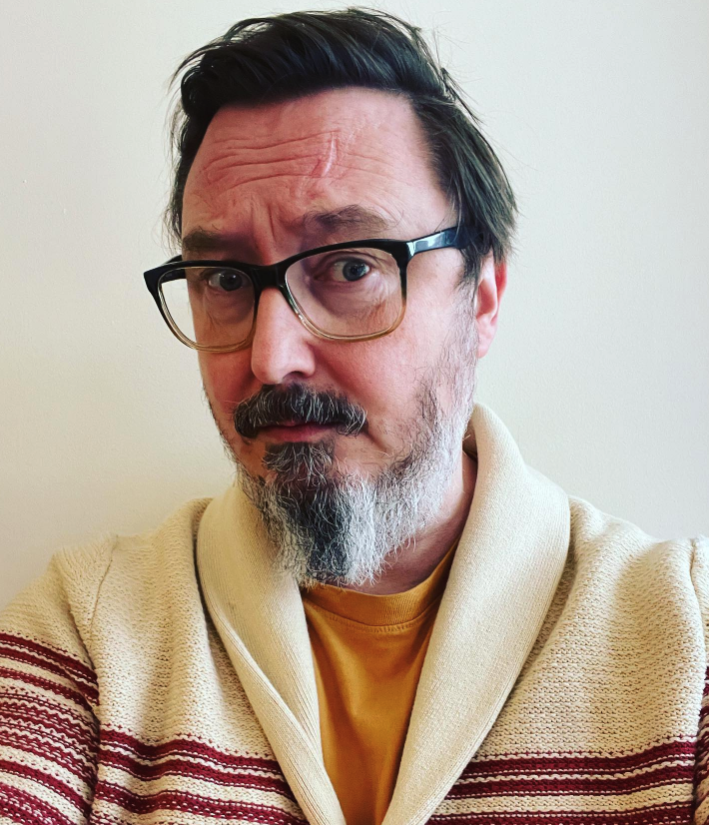
Years ago I demonstrated on Facebook how my voice could be simulated. Now a single image of me can be manipulated into infinite forms that continue to become more and more realistic. That is one reason that when a meme circulated of women creating a Christmas photo using an AI prompt on a single uploaded self-portrait, I chose to create and share a couple of silly AI Christmas photos that hundreds of my Facebook friends laughed at with me.
In December 2025, an AI prompt could easily transform my photograph as shown
But our laughter echoes in a shared world where typical evidence is becoming as uncertain, as misleading, as the typical false conceptions of matter and space. Skepticism is now required, but that brings with it the erosion of trust.
For decades we have stressed the importance of critical thinking skills, but social media continually reveals how uncritical and unintelligent many of us must inevitably remain, splayed out across the statistical bell curves of ability. The suckers continue to be born every minute.
Young and old fail to distinguish artificial intelligence hallucinations from established truths. Scientific evidence and rigorous research are discounted, misinterpreted, defunded, and demeaned by influential media and government figures, motivated by their personal politics and biases, who lack earned credentials or credibility. But to many that will not matter, for their trust in institutions and expertise has been steadily eaten away, replaced with blind beliefs built by partisanship, culture wars, and demagoguery.
We live in an age that is both wondrous and tragic. It will require time, effort, and patient perseverance for our cultural norms and institutions to adjust to our new capabilities, with no guarantees of success, only continued challenges.
I do not despair, for there is much utility in the new technologies, much potential to better inform and perform. Our quality of life need not collapse amidst wrenching change if enough of us heed the call to help each other cope. However, we must recognize that our shared reality, already misunderstood by most, continues to shatter. It is up to us to decide if we are to act as hammer or glue.





















 Meador Manor